Checking In on GPT 5.1
kill-the-newsletter.com
Hello, and happy Sunday! Was this newsletter forwarded to you? Sign up to get it in your inbox. Vibe Check: GPT 5.1When someone on X pointed out how quiet the GPT-5.1 launch felt, Sam Altman replied, “ Better to do it that way than the alternative, I have learned.” After GPT-5’s noisy debut —and weeks of people complaining that ChatGPT felt worse—OpenAI released 5.1 with little fanfare. Same price tier, pitched as smarter, friendlier, and better at coding and agents, but the implied message is: “We fixed it, go try it.” Here’s how it’s landing inside Every after a few days of use. It’s slower than GPT-5, but more comprehensive“I think GPT 5.1 in Codex is slower (but maybe it’s only for closed testing, not sure), but it seems like a quality update where it nails more from one go and a bit better in UI work. It also gives more comprehensive and verbose overviews of its work when it’s done.”— Andrey Galko, engineer The extra thinking time isn’t always worth it“It’s slower and thinks much more compared to GPT-5-Codex High. I gave the same simple task to GPT-5-Codex and GPT-5.1-Codex to understand the vibe. I like GPT-5-Codex better.”— Naveen Naidu, general manager of Monologue It struggled with complexity“I was just doing a major refactor that involved splitting a really large file into a bunch of smaller files… and 5.1 really struggled. I would compress the context window. And it just didn’t want to do the work despite all of the tricks that usually work great with GPT-5.“— Danny Aziz, general manager of Spiral It asks useful clarifying questions”Guys I love 5.1. It asks quick clarifying questions and makes the output better consistently!”— Natalia Quintero, consulting partner It has a warmer vibe“I missed the memo that 5.1 had dropped until after work when I was researching Bible translations with my ChatGPT Bible study buddy. I definitely notice the warmer, chattier personality and quicker turnaround on thinking tasks.”— Katie Parrott, staff writer and AI editorial lead As the name suggests (it’s not 5.5 or 6, after all), GPT-5.1 is not a mind-melting new intelligence. It feels like OpenAI has sanded down the rough edges of GPT-5: better behavior, more reliable coding, a bit more patience and care in how it responds. If you bounced off 5, it’s worth another shot—especially if you live in Codex, build agents, or like models that pause to ask, “Wait, what did you mean by that?” before they answer.— Katie Parrott Knowledge base“AI Solved the Problem I Couldn’t Explain to Managers” by Katie Parrott/Working Overtime: Katie Parrott wouldavoid email for weeks, miss deadlines, and lose job opportunities—ripple effects of her bipolar disorder that made steady employment impossible. Medication, therapy, and more got her on track. But Cora, Every’s AI email assistant, stripped out the clutter so she could finally see the three or four emails that mattered. Read this deeply personal essay to understand how AI can make work sustainable in an unexpected way. “Where Explanations End” by Dan Shipper/Chain of Thought: In 430 B.C., Socrates humiliated the venerated teacher Protagoras by asking a simple question: How can you teach excellence if you can’t define it? Two thousand years later, neural networks answered—they learn without definitions, trained on vast amounts of data rather than explicit rules. Read this short story from Dan Shipper about what happened next to Protagorasto see why AI’s approach to learning might vindicate the Athenian teacher. 🎧 “He Built AI Agents to Launch a Million Businesses” by Rhea Purohit/AI & I: Henrik Werdelin built Barkbox and a first-class airline for dogs. Now he’s taking everything he learned there and at his startup studio Prehype and building Audos, a platform where AI agents help entrepreneurs brainstorm, finance, and market their businesses. In this conversation with Dan, Henrik breaks down his framework for “relationship capital,” why “customer-founder fit” matters more than product-market fit, and his belief that we’re heading toward 1 million businesses making $1 million. 🎧 🖥 Listen on Spotify or Apple Podcasts, or watch on X or YouTube. “AI Ran Out of Internet. Now It’s Learning by Playing Games Again.” by Alex Duffy/Playtesting: AI can win gold medals at math olympiads and diagnose diseases like human doctors, but it also fabricates legal cases that don’t exist and gets attorneys fined. It’s a data problem: Models are trained on data from the public internet, which has a lot of good information on some things, but is sparse in other areas. In the first edition of our new column, Playtesting, Alex Duffy, cofounder of Good Start Labs (an Every-incubated company), explains how games can fill in those gaps and help AI get smarter. Read this to understand why synthetic playgrounds will help AI level up. From Every StudioSingle sign-on arrives for Spiral and SparkleEvery subscribers can now access Spiral and Sparkle with one unified login—no more hunting for which email unlocks your bundle. Sign in with your Every account and your existing data from both apps automatically connects. Cora support is coming soon, and more unified account features are in development. If you’re an Every subscriber, just sign in with Every to get started. Monologue user crosses one million words dictatedFrédéric de Lavenne de Choulot, a software engineer and AI consultant, is the first Monologue user to dictate 1 million words—producing documentation and product ideas three times faster by speaking instead of typing. He uses it daily to design technical systems out loud and write while coding, staying in flow without the friction of the keyboard. Monologue general manager Naveen Naidu awarded him the first Monokey, a limited-edition physical key you can press to start instant dictation (pictured below—more details coming soon on how you can get your own). Download Monologue at monologue.to.  Claude Code for Beginners is this weekOn November 19, Dan Shipper will be hosting a workshop that’s perfect for anyone who’s been wanting to learn Claude Code. The day-long session will take you through installation and setup to a live project and a repeatable, reusable workflow—no coding experience required. Learn more and sign up. AlignmentOn taste. “The cast stars in the steel grey fabric of the sky seemed to struggle and wink against the night.” I’ve underlined that sentence from John Steinbeck ‘s To a God Unknown over and over again. To be honest, I do this with almost everything he writes. I try to collect moments that have that ineffable quality, that thing that rings true and makes you think wow, I’ve just been transported to Salinas Valley. For a long time, I couldn’t understand how he did it. Not until I read Dan’s essay on taste and tried feeding all of my underlined Steinbeck sentences into Claude. What came back made the hairs on the back of my neck stand up: “He writes landscape like it is visceral and living and breathing.” Yes! That’s what I’d been sensing. Steel grey fabric—the sky has texture, warmth, something you can almost touch. Compare that to simply saying ”dark sky.” And struggle and wink—two verbs that shouldn’t exist together but, when combined, create vibrant tension between beauty and hardship. This is California as an emotional landscape that’s almost as important as the story itself. Dan writes about taste as a naming problem. Your brain knows what it likes but can’t articulate why. This is where LLMs become incredibly powerful for creative people because they give you the language for what you already sense. Now when I write and want to invoke Steinbeck, I feed my work into Claude, and it spits out “too flat” or “give the words tension.” The bridge between sensation and language finally exists for me. When I visited California earlier this year, it was in some ways as though I had already been there. The hills, the light, the way shadows fell. Steinbeck had made the place real before I ever saw it.— Ashwin Sharma That’s all for this week! Be sure to follow Every on X at @every and on LinkedIn. We build AI tools for readers like you. Write brilliantly with Spiral. Organize files automatically with Sparkle. Deliver yourself from email with Cora. Dictate effortlessly with Monologue. We also do AI training, adoption, and innovation for companies. Work with us to bring AI into your organization. Get paid for sharing Every with your friends. Join our referral program. For sponsorship opportunities, reach out to sponsorships@every.to. Get More Out Of Your SubscriptionTry our AI tools for ultimate productivity 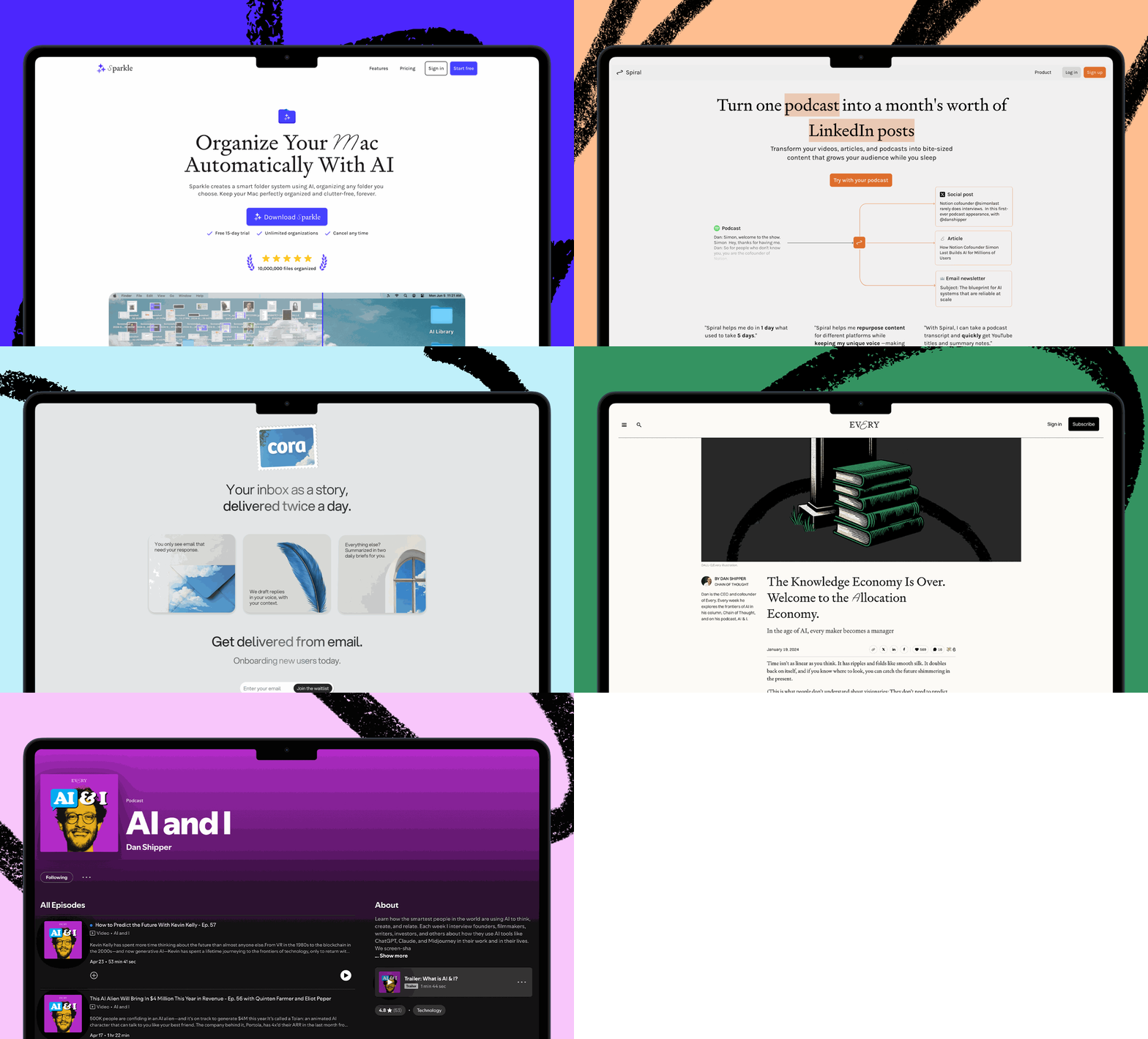 Front-row access to the future of AI In-depth reviews of new models on release day Playbooks and guides for putting AI to work Prompts and use cases for builders Bundle of AI software Sparkle: Organize your Mac with AI Cora: The most human way to do email Spiral: Repurpose your content endlessly Monologue: Effortless voice dictation for your Mac |